Shifting Weathers
Susanne Kriemann, Jasmijn Visser (with Ingmar König), Luiz Zanotello
Villa Heike Kunstverein
26.03–02.05.2026
Heat records. Wildfire seasons. Storm systems forming somewhere on the planet. In recent years, we have increasingly encountered climate through headlines: as a measurable quantity, seen in satellite images, temperature readings, and predictive models, as something recorded, calculated, often far beyond our immediate experience.
Weather, by contrast, rarely enters our lives in such an abstract form. It is deeply rooted in our sensory experiences, routines, and cultural customs. It settles in the body, in everyday rhythms, in language. Between these two levels, measured climate and lived weather, there emerges a shift that shapes how we perceive and understand atmospheric change.
This fragile envelope that sustains life on Earth is now undergoing profound transformation. The climate crisis reveals how tightly human actions are entangled with planetary processes. Against this backdrop, climate also becomes a matter of perception: how we experience the atmosphere, how we imagine change, and how images shape these perceptions.
These questions have guided the curatorial approach of Shifting Weathers. The works in the exhibition engage with these themes through diverse artistic strategies of observation and representation. Shifting between material processes, digital environments, and systems of monitoring, they explore how climate becomes perceptible and how its representations shape our lived experiences and understanding of planetary change.
Susanne Kriemann’s work Datadust skin of sand reflects the slow imprint of human activity on landscapes. Drawing on archaeological sites in the deserts of Al-Ula and Tayma, Kriemann traces the coexistence of ancient artifacts and contemporary waste. Photographs of collected clothing remnants are transformed into silkscreens, coated with date syrup, microplastic-infused makeup, and finally coated with desert sand. Through these materials, the work shows how microplastic is inscribed into ecological cycles and marks human presence across deep time.
In collaboration with game developer Ingmar König, Jasmijn Visser presents the interactive video game The weather has been cancelled. The work imagines a world where weather has been eliminated, starting from the observation that climate models provide data but scarcely convey how deeply weather is embedded in perception and everyday life. Within the fragmented digital landscape, visitors navigate spaces of absence and disorientation. Rather than representing climate change directly, the game makes palpable the difficulty of grasping a crisis that unfolds unevenly across time and space. In collaboration with Shortnotice Studio, the work has also been translated into a publication.
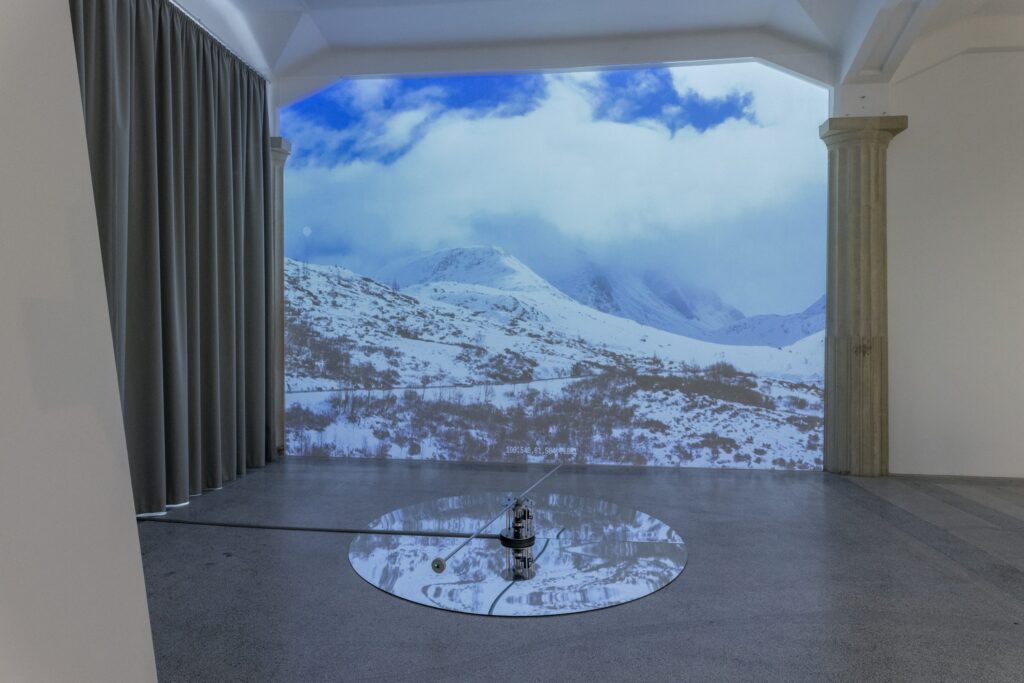
Luiz Zanotello’s installation Tempo-imagem shifts attention to the global infrastructure of atmospheric observation. Drawing on live feeds from publicly accessible weather cameras worldwide, the work shows how weather is continuously recorded, processed, and distributed via technological networks. By training a machine on these images, Zanotello highlights the unequal geographies and temporalities embedded in global observation systems. Also on view by is a still from the video At the periphery of events, showing a weather station in Brazil immediately after a tropical storm. Printed on fabric and hung at the entrance, the image floats lightly in the air, moving with wind and currents.
Together, these works turn away from the familiar visual language of climate catastrophe. They draw attention instead to slow processes such as sedimentation, circulation, and observation. They invite us to consider weather as a dynamic field in which human action, technical systems, and planetary forces intersect.
For me, curating Shifting Weathers was an attempt to create a space to reflect on this condition. Weather is rarely still. It moves through currents and particles traveling across landscapes and continents. Attending to these movements also means acknowledging how deeply our lives are entangled with the surrounding atmosphere, and the role we play within it.