The Walls That Move, as We Move Within Them – An Encounter Between Architecture and the Body
On the occasion
03.09.2026
“In the middle of the 12th century. In the lonely, rugged, sun-drenched and wooded landscape of Provence, a group of monks began to build an abbey. A place of detached life, dedicated solely to contemplation and prayer, was to be built." This is the description of the novel Les Pierres Sauvages (The Stones of the Abbey) by the French architect Fernand Pouillon that architect Michael Ragaller gave as a tip after our conversation about the St. Fidelis church. Michael Ragaller and Domenik Schleicher are the architect duo behind schleicher.ragaller who completed the conversion and renovation of St. Fidelis Catholic Church in Stuttgart in 2019. A project that, as in Pouillon's novel, is about a sacred building site that is transformed into a place to be inhabited. The novel is a reflection on the relationship between the beautiful and the necessary, the human order and the natural order. It is a poetic story on the art that brings all others together: architecture.
In my conversation with the architects, I learned that in their process they, too, had to deal with essential elements such as the existing architectural structures of the church, including the original design by Richard Schwarz and the glass windows by George Meistermann, but also with their desire to create a homogeneous and serene aesthetic. The idea behind the renovation was to provide a place for something different in the field of spirituality, such as mediation or yoga with impulses from film, art, music or dance, in addition to the church use. On the one hand, it needed to be an enclosed space so that the large room is still accessible during use, and on the other hand, there should be the possibility of being connected to the whole area. The architects removed everything that was distracting, took out the altar and the ambo, replaced them with a newly designed piece by artist Martin Bruno Schmid, built of 14 tons of Roman travertine, and a flexible space was built in the place of the former altar. The newly designed space with oak walls blends into its surroundings and becomes a place of refuge, of silence. It has several doors and a roof that can be opened to let in light and transform according to use. For DIMORA it is the starting point from which the performance unfolds.
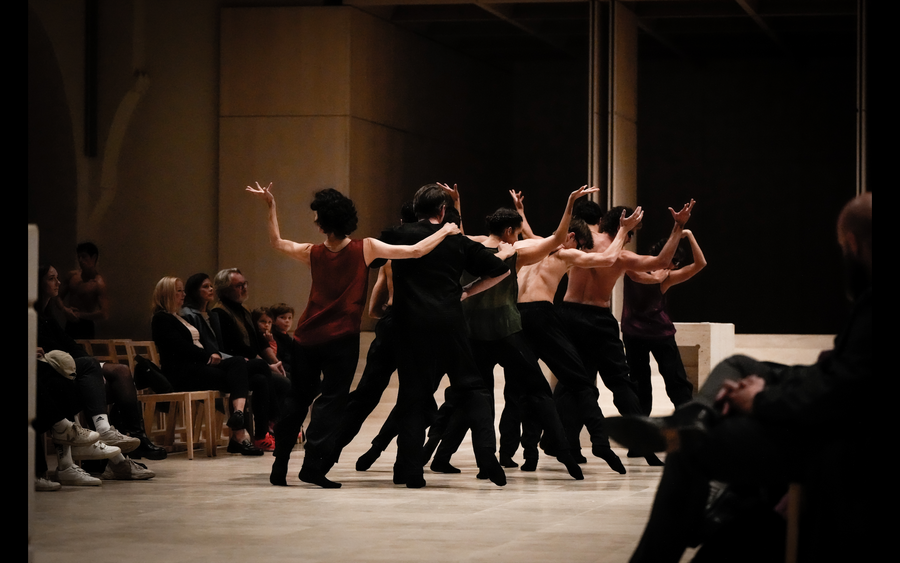
DIMORA portrays the enlivenment, habitation and occupation of living spaces that is poetically depicted by the dancers bodies, while using the St. Fidelis Church as its stage. Throughout the performance, we see the performers bodies resonating, echoing and moving within the architectural structure of the church, as they gradually uncover different notions of dimora. The given environment is both a constraint and a structure around which the performance is formed. For choreographer Alessandro Giaquinto, the space was a source of inspiration, where every limitation was turned into a solution, making the performance a site-specific piece that would not be the same anywhere else. Within the architectural structures, the choreographic concepts of ephemerality, physicality, scoring and performativity are challenged. As a result, the performance and the spatial structure intersect and transcend each other, thereby becoming spaces for the dancers to inhabit.
During DIMORA there is no front, no back; the dancers move through the space like free-flowing residents, but with their choreographed steps and pace, they respond to the sounds that echo from the musical instruments. The rhythm that they follow is not so much a matter of sound, but one that emerges from the materials from which our building space is constructed, a rhythm that can be experienced and inhabited. The precision and concentration of the dancers within these walls are captivating - especially at moments when the spatial environment is exposed and transformed through their movements. By closing and opening doors, by stamping on the floor, by banging their heads against the walls or by the rhythmic movement of their bodies aligning themselves in the space.
As I observe the movements of the dancers in the space, I cannot help but think of how the places we live in move with us as we move within them, like a continuously living entity. Sometimes it behaves violently, sometimes tenderly, sometimes we feel its oppression and sometimes its openness. DIMORA portrays this in the dancers' movements that alternate from exhilaration and joy to violence and tenderness, revealing the way our bodies experience and inhabit spaces. In doing so, they draw the spectator's attention to the physical specificity of each dancer in relation to the surrounding elements, thereby bringing to the fore that our bodies cannot be separated from the spaces we inhabit.